
MTP/MPO-16 SC Footprint Opposed Key Fiber Adapter with Flange
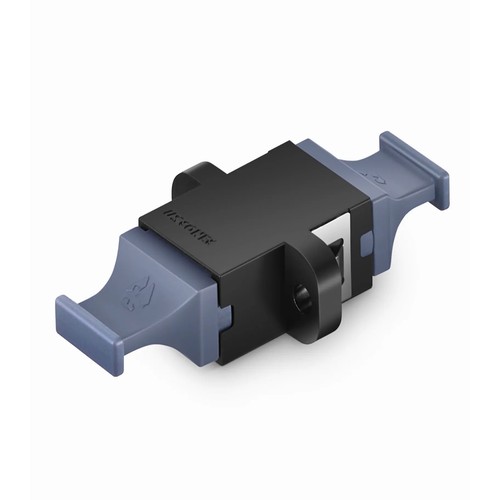
High-density designs should assess this item together with panel access, cable routing and the complete optical loss allowance. MTP/MPO-16 SC Footprint Opposed Key Fiber Adapter with Flange mounts MPO/MTP trunk interfaces on the patch panel: precision alignment keeps the multi-fiber ferrules registered on their guide pins, and the housing keys the orientation so polarity is preserved across every mating. One adapter presents a full parallel-optics slot as a single, documented port.
Product Highlights
- ≤0.35dB (Typical) Low Insertion Loss
- Dust Plugs Keep Adapter’s Interior Clean from Dust
- Stainless Steel Clips for Tool-less Snap-in Installation
- Apply to 400G High-density Connections
- Available in A Variety of Connector Types
Specifications
| Connector Type | US Conec MTP®/MPO |
|---|---|
| Keyway | Opposed (Up-Down) |
| Footprint | SC |
| Insertion Loss | ≤0.35dB |
| Durability | 1000 times |
| Flammability Rate | UL 94V-0 |
| Dust caps are provided with the fiber optic adapter to protect it from dust and maintain cleanliness.Good design! | |
Phosphor bronze and zirconia sleeves compared
Two sleeve materials dominate the MMC adapter market. Zirconia ceramic sleeves give the tightest alignment and are the specified selection for single-mode and high-performance multimode work, where core geometry leaves no room for eccentricity. Phosphor bronze sleeves serve legacy multimode and metallic-ferrule connectors where the tolerance requirement is looser and the cost matters more. Matching the sleeve to the application keeps both performance and budget under control.
Key orientation and polarity in MPO adapters
An MPO adapter does more than hold two connectors: it defines the polarity of the whole channel. Key-up to key-down adapters mate opposed connectors so fiber slot 1 meets slot 1 in a straight-through plant; key-up to key-up versions serve specific polarity methods. Specifying the wrong orientation flips the transmit and receive lanes and the channel just never comes up. The MMC adapter datasheet states the key orientation, and the order must state it too.
MPO adapters at the trunk panel
Parallel-optics trunks terminate on MPO adapters at the patch panel, and the patch panel is where trunk density is won. MPO adapters adhere to the SC simplex footprint; consequently, standard panel cutouts accept them directly, and the corresponding panel may carry LC breakout positions beside MPO trunk positions. That mixing ability is what makes MPO panels practical: trunks arrive on MPO, and breakout cassettes or harnesses convert to duplex LC where the active hardware needs it.
Panel cutouts and footprint discipline
Adapter panels are standardized around a handful of footprints, and the SC simplex footprint is the most common: duplex LC adapters are built to drop into the corresponding cutout, which is why LC and SC positions interchange freely on modern frames. Keeping to the standard footprint matters when a panel is re-loaded years later - the replacement adapter must fit the hole that is already there.
What adapter testing actually measures
Because an adapter contributes no signal of its own, its test is a mating test: reference connectors mate through the MMC adapter, and the inserted loss is recorded. A zirconia-sleeve adapter should add no more than 0.2 dB, and the mating must repeat that figure across cycles. Durability testing runs the mating hundreds of times and re-measures - a sleeve that wears loose announces itself as creeping loss. These figures, not the housing color, are what separates an adapter that serves for years from one that becomes the mystery fault.
Selecting the right adapter for the panel
Five decisions define the MMC adapter order: this connector interface pairing must correspond to both sides of the mating, the mounting style must fit the patch panel cutout, the polish color code must correspond to the plant, the sleeve material must suit the performance grade, and the count must cover the load-out plus spares. Getting all five right at order time is what turns a bag of couplers into a dependable panel. Where the pairing crosses connector families, the hybrid range covers the common conversions.
Quality Control and Testing
Every adapter is inspected before packing: the sleeve bore is checked for alignment and surface finish, the housing latches are cycled for positive engagement, and sample matings from each production lot are measured for insertion loss. Accessories are checked for fit against the adapters they serve. This check should form part of the rack-access and acceptance review.
Ordering and Factory Support
Refer to this adapter by connector pairing, mounting style, polish grade and pack quantity during the request for a quotation. For configurations outside the listed options - mixed packs, panel hardware kits or project packaging - send the requirement with the enquiry and the factory will review the manufacturable specification. Project orders can be reviewed for interface compatibility, packing details and delivery coordination.
Purchase with confidence
Get a quick quote
Please write to sales@huihongfiber.com, we will reply as soon as possible.
Fiber cable assemblies
Transceivers and cables
Testers and tools
| Fiber Optic Test Equipment |
| Fiber Optic Tool Kits |
Huihong TechnologiesAdd:6F,1st Bldg,ZYT industrial park, Shiyan area,Shenzhen,ChinaEmail:info@huihongfiber.com Tel: 86.755.61230063 Specialized fiber optic products manufacturer. |
Fiber Optic Quick Guide |
News and ExhibitionsCompany news and exhibitions schedules for this year and next year. click here for details . |
Fiber Optic Applications
|
Customer Support
|


Copyright © 1998 - 2015.
China fiber optic manufacturer and china fiber optic cable supplier,fiber optic transceiver manufacturer.


